
How Long Does an Oil Portrait Take? From Photograph to Finished Painting
The painting schedule is only one part of the journey. A reliable completion date accounts for everything around it.
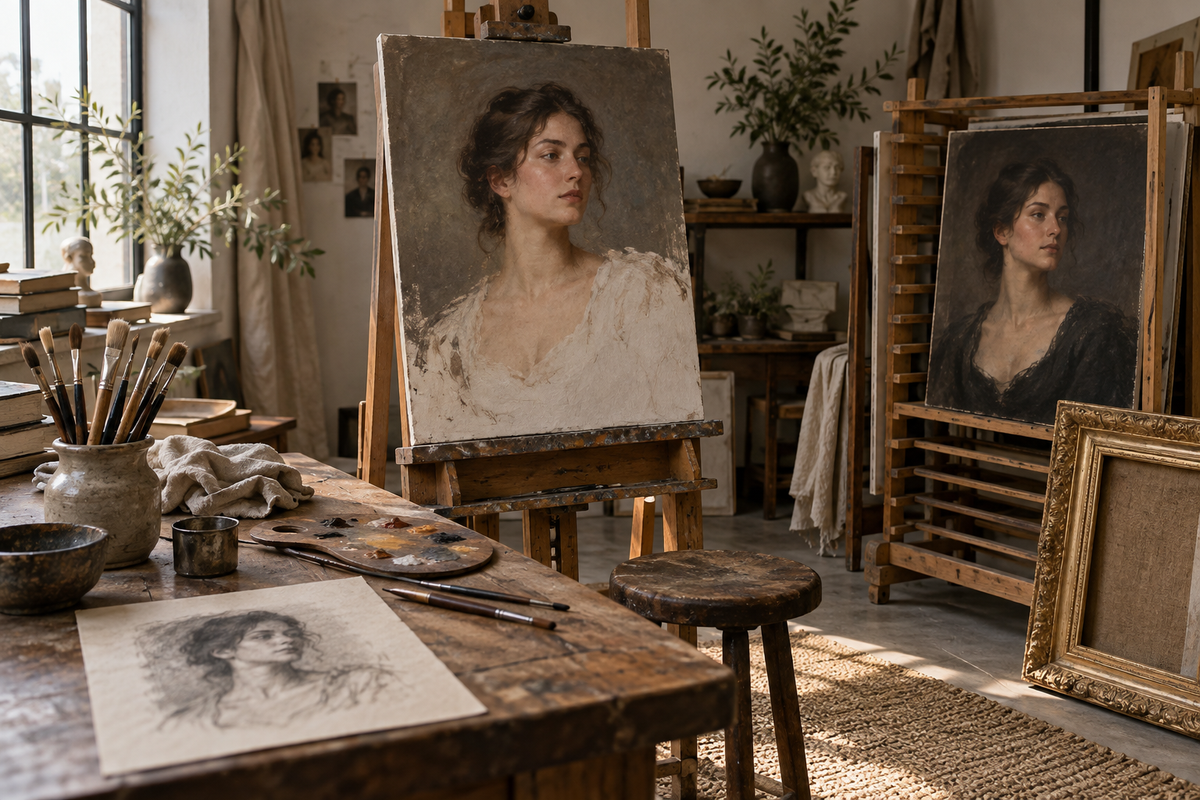
The painting schedule is only one part of the journey. A reliable completion date accounts for everything around it.
A conceptual view of several stages in a commission. AI-generated imagery, not a record of a real production schedule.
If a portrait is connected to a birthday, anniversary or family gathering, the first question may be a date. It is a good question to raise early.
There is no single timescale for an oil portrait. The artist's availability, complexity of the composition, reference material, review process and finishing requirements all affect the schedule. Ask for an estimate for your particular commission and clarify whether it refers to approval, dispatch or arrival.
The schedule begins before painting
The first stage is establishing what will be made. References are reviewed, the sitters and crop are agreed, and the intended size, setting and scope become clear. Sometimes the existing photographs provide everything needed. Sometimes an additional view or a new photograph resolves an important uncertainty.
A commission may also wait for a place in the studio schedule. Ask when work can begin as well as how long it is expected to take once underway. Those are different questions.
Composition is time well spent
A study allows the essential arrangement to be discussed before the portrait is developed. In a family composition, scale, posture and relationships may need particular attention.
Prompt, consolidated feedback helps this stage move forward. If several family members are involved, agree who will gather their comments. A clear decision about the composition can prevent much more disruptive changes later.
Painting includes intervals as well as sessions
The visible work may advance through drawing, broad masses, modeling and refinement. Some passages can be worked while wet; other approaches depend on allowing an earlier layer to become sufficiently dry.
Drying behavior varies with the paint, medium, thickness and conditions. Winsor & Newton's guidance distinguishes drying behavior across its oil colors. That variation is one reason a simple count of painting hours does not translate directly into a delivery date.
Review can change the next step
When you review the portrait, focus on likeness and meaningful details. Give specific observations rather than a list of unrelated image adjustments. If something feels unfamiliar, describe it: the expression seems more severe, a head appears too upright, a characteristic detail has been lost.
Some adjustments are local. Others affect surrounding forms and take longer to resolve. Ask how the agreed review process works, what is included and how a substantial change in scope would affect timing.
Approval is not the same as readiness to ship
A painting can look complete before its surface is ready for handling and packing. Finishing may include additional drying, an appropriate surface treatment, framing and preparation for transport.
Varnishing also depends on the product and paint film. For example, Gamblin's guidance for Gamvar refers to a surface that is dry to the touch and firm in the thickest areas. Other varnishes have different requirements. There is no safe universal shortcut to insert into every commission's schedule.
The useful client question is how the artist has allowed for the finishing system being used. Let the artist assess the surface; do not test or treat a newly delivered painting yourself.
Allow time for the finished object
A frame may need to be selected or made. Packing and delivery require coordination, especially for larger works or destinations with additional transport requirements. An estimated dispatch date is not an arrival guarantee.
Confirm which milestone matters to you. If the portrait must be in place for an event, tell the atelier the actual date at the beginning and ask whether that arrival can be supported. Include the destination and any installation constraints.

A timeline to discuss
The sequence to review is: inquiry and reference selection; agreed scope; studio start; composition approval; painting; portrait review; finishing and drying; framing and packing; dispatch and arrival.
Some stages may overlap, while others depend on an earlier decision. Ask which dates are estimates and which commitments can be made. If a material choice or late change affects the plan, the schedule should be updated accordingly.

When the occasion is close
Be candid about the deadline before commissioning. A simpler composition may help with some parts of the work, but it does not remove the need for appropriate drying and handling.
If the finished portrait cannot arrive in time, consider giving the commission itself as the gift, with a personal note about the person or moment you hope to have painted. Discuss what the atelier can provide for that occasion. The recipient may enjoy taking part in the decisions that follow.
Begin with a clear date and an open conversation
Send your photographs, the intended composition, destination and any deadline that matters. A useful schedule will connect those details to the actual work ahead.
Knowing what happens between the photograph and the finished painting makes waiting easier to understand. More importantly, it helps everyone plan for the same outcome.
Related reading
- From First Mark to Final Glaze: How a Portrait Is Painted
- How to Commission a Portrait from a Photograph
- How Much Does a Commissioned Portrait Cost?
Further reference: Winsor & Newton: oil colour drying times; Gamblin: varnishing guidance.