
How to Commission a Portrait from a Photograph
Learn how photographs become a commissioned painted portrait, from choosing references and shaping the composition to review, framing and delivery.
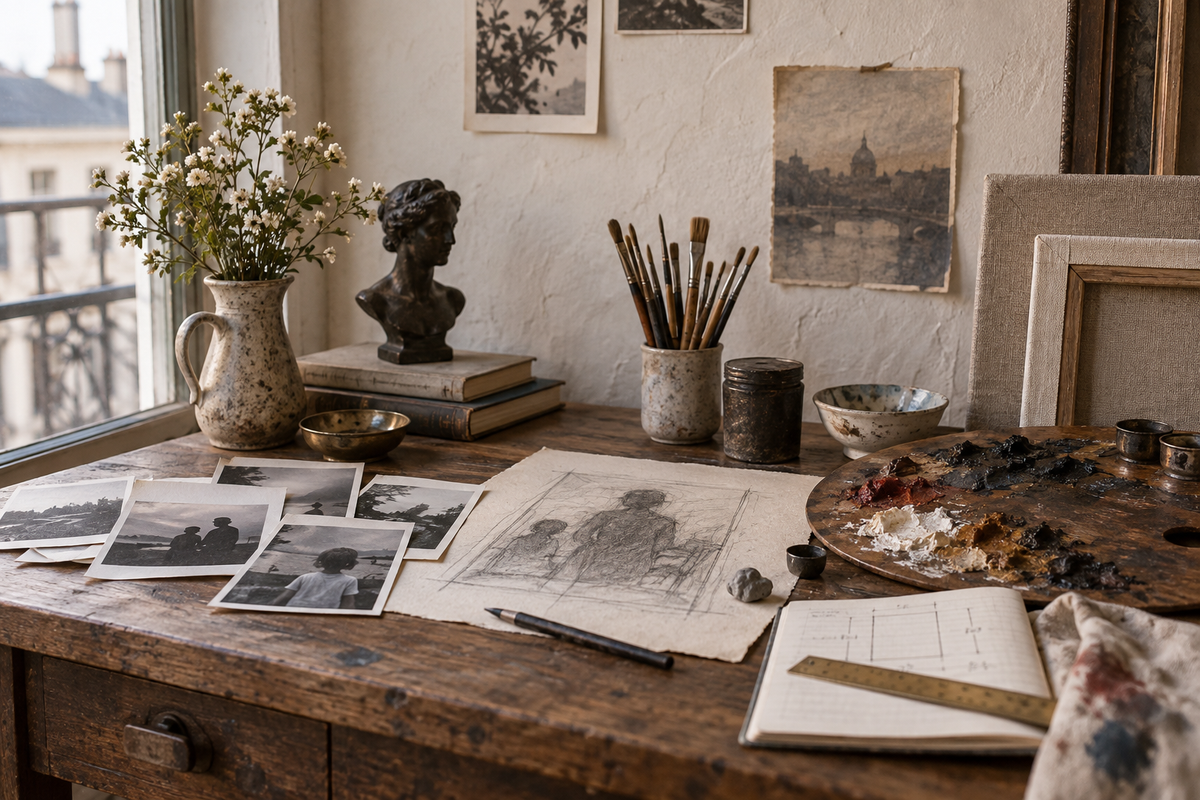
A clear guide to choosing photographs, shaping the composition, reviewing the work and understanding what happens from the first conversation to the framed painting.
Featured image: AI-generated conceptual atelier still life; not client documentation.
A portrait can begin with a photograph
Many people imagine that commissioning a portrait begins with a formal sitting. It can. But it can also begin with photographs you already have: the image that catches a familiar expression, the quiet picture taken at home, or several references that reveal different parts of a person.
The photograph is the beginning of the process, not the finished idea. A painted portrait does more than reproduce what a camera recorded. It brings together observation, composition and judgment to decide what should remain, what can recede and how the person should be present on the canvas.
That distinction is what makes a photograph-based commission both practical and deeply personal. You do not need to arrive with one flawless image. You need photographs that help us understand the person you want painted.
1. Begin with the person, not the perfect photograph
The first conversation is about more than image quality. It is about the subject of the portrait and why this particular person, relationship or moment matters.
Who will be included? Is the portrait intended to feel intimate or formal, quiet or lively? Where might it live? Are there gestures, expressions or ways of carrying themselves that family members immediately recognize? These questions guide every decision that follows.
A technically polished photograph can be useful, but it is not automatically the best reference. Sometimes a casual image contains the expression that feels most true. Another photograph may show the posture more clearly. A third may help with clothing, scale or color. Together, those images can give the painter a fuller understanding than one perfect-looking picture ever could.
2. Share a group of photographs
When possible, send a small group rather than trying to make the final choice alone. Include the obvious favorite, but also include photographs that show the person from nearby angles, in different light or with a more characteristic expression.
Useful references often reveal:
- a clear view of the face and eyes
- the natural shape and turn of the head
- a recognizable expression rather than a forced smile
- posture, gesture and the relationship between sitters
- clothing or objects that genuinely belong to the person
- enough light and detail to understand form
The photographs do not all need to be beautiful. They need to be informative. The atelier can help distinguish the image that should anchor the portrait from the images that are useful as supporting evidence.
If new photographs are needed, the goal is not to stage an elaborate photo shoot. It is to create clear, honest material from which a portrait can be composed.

3. Decide what the portrait should become
Before paint is involved, the commission takes shape through a series of choices.
The subject. One person, a couple, children, a family or a beloved animal may each suggest a different kind of composition.
The crop. A head-and-shoulders portrait feels different from a three-quarter or full-length figure. The right crop depends on the person, the room and the emotional distance the portrait should hold.
The setting. Some portraits benefit from a recognizable interior or landscape. Others become stronger when the background is simplified so that expression, gesture and light carry the painting.
The scale. Size should be considered in relation to the sitter and the space where the work may live. A small portrait can feel intensely private. A larger work can hold a room.
The atmosphere. Light, color, clothing and the degree of finish all shape how the portrait feels without changing who the person is.
These are not decorative choices added after the fact. They are part of how the portrait makes meaning.

4. The composition is developed and agreed
A photograph contains many accidents: an awkward crop, an object in the background, a momentary tension in the hand, or lighting that is useful for one feature and unhelpful for another. Painting allows those accidents to be reconsidered.
The painter may adjust the placement of the figure, simplify the setting, combine information from several photographs or refine the relationship between sitters. The aim is not to invent a different person. It is to build a coherent image from the best available evidence.
Before the full painting proceeds, the composition should be clear enough for the client to understand its direction. This is the moment to confirm the essential structure: who is included, the crop, the setting, the broad arrangement and the character of the portrait.

5. The painting is built through layers of judgment
Once the composition is established, the portrait develops through drawing, color, correction and refinement. The painter is continually comparing relationships: the tilt of the head, the interval between features, the weight of a gesture, the temperature of skin against the background and the degree of detail each area needs.
Likeness does not come from copying every visible detail with equal emphasis. It comes from recognizing which details carry the person. A familiar asymmetry, a reserved expression or the particular way someone turns toward another sitter may matter more than photographic sharpness.
This is why the painting stage cannot be reduced to a filter or transfer. The work advances through choices, and often through revision. The finished portrait should feel resolved without losing the life of its making.
6. Review should protect the likeness, not flatten the painting
A review is most useful when it focuses on recognition and meaning. Does the expression feel true? Does the relationship between sitters make sense? Is there an important detail the painter could not have known from the photographs alone?
Family knowledge can be invaluable here. At the same time, a portrait must remain a painting. If every edge is sharpened and every photographic detail restored, the work can lose hierarchy, atmosphere and coherence.
The best review process combines the client's intimate knowledge of the subject with the painter's responsibility for the image as a whole.
7. Framing and placement complete the commission
A frame is not simply packaging. It creates the transition between painting and room. Its proportion, color and surface should support the work without overwhelming it.
Placement matters too. The height, surrounding furniture, light and viewing distance all affect how the portrait is experienced. These considerations can begin early, especially when scale is still being chosen, and return when the finished work is ready for its home.
The commission ends not when the final brushstroke is made, but when the portrait can be lived with as an object: framed, installed and seen over time.
What you need before you begin
You do not need a complete visual plan or a single perfect photograph. A useful starting point is simpler:
- the person or people you would like painted
- several photographs that feel recognizably like them
- any practical constraints, including intended timing
- an idea of where the portrait might live, if known
- details that matter and should not be overlooked
From there, the atelier can help identify what is strong, what is missing and what the portrait might become.
Frequently asked questions
Do I need to sit for the artist?
Not necessarily. A carefully directed set of photographs, or a thoughtful selection of existing images, can provide the material for a deeply observed portrait.
Can one portrait be made from several photographs?
Yes. Separate references may contribute expression, posture, clothing or information about different sitters. The challenge is to reconcile them into one believable composition rather than treating them as separate cutouts.
Can the background or clothing be changed?
Often, but every change should be grounded in enough visual information to remain convincing. The atelier should explain what can be interpreted confidently and where better references are needed.
Can an old or damaged photograph be used?
Sometimes. The painter must distinguish what the photograph genuinely shows from what would have to be invented. Additional family photographs can help recover missing information.
How long does the process take?
Timing depends on the composition, number of sitters, review, painting, drying, framing and delivery. It is best discussed at the beginning, especially when the portrait is connected to a gift or occasion.
How much does a commissioned portrait cost?
Price reflects size, number of sitters, complexity, framing and the artistic work involved. A clear proposal should explain the scope of the commission before work begins.
Begin with the photographs you have
The first step is not choosing the final image by yourself. It is opening a conversation about the person you want painted.
Share the photographs that feel most true—even if you are uncertain which one is best. We can look at expression, light, composition and the possibilities for the finished work, then decide what additional material, if any, would make the portrait stronger.