
From First Mark to Final Glaze: How a Portrait Is Painted
A portrait develops through decisions that remain visible even when the first marks have disappeared.
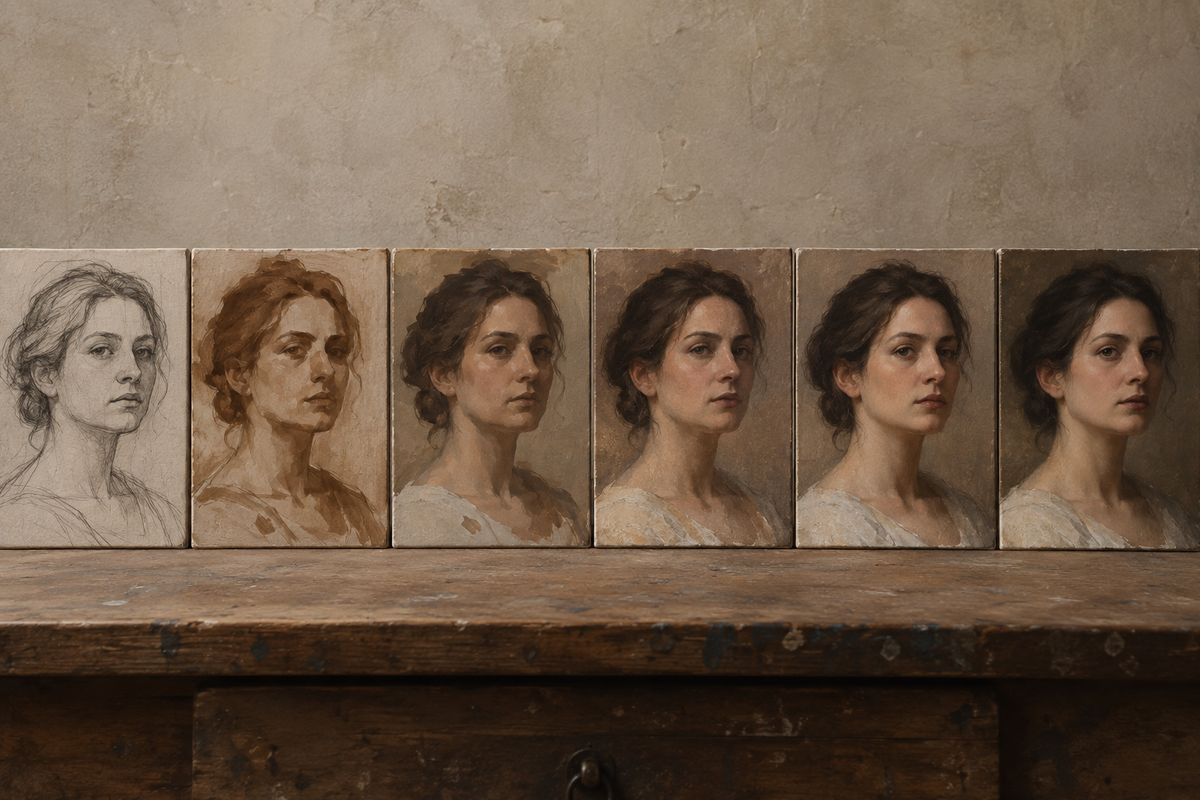
A portrait develops through decisions that remain visible even when the first marks have disappeared.
A conceptual sequence illustrating a layered approach to painting. AI-generated studies, not documentation of an Atelier Vigée commission.
At the beginning of a portrait, very little looks finished. The head may be a few lines. The face may be divided into broad patches of light and dark. A familiar expression has not yet arrived.
This early uncertainty is useful. It gives the painter room to establish the relationships on which the likeness will depend. The sequence below explains a layered approach to oil portraiture. Artists vary their methods, and stages may overlap or be revisited; it is a guide to the decisions, rather than a claim that every portrait follows one recipe.
1. The composition is settled before detail
The first work is deciding what the image will contain. How much of the body should appear? Where will the head sit within the canvas? What space is needed between two people? Should the background describe a room or simply hold the figure?
Small studies make these choices easier to see. They allow a painter to compare arrangements before investing in detail. For the client, this is the moment to discuss essential facts: the sitters, pose, crop, clothing and overall atmosphere.

2. Drawing establishes the structure
Drawing locates the main forms and their proportions. The tilt of the head, slope of the shoulders and position of the hands matter before eyelashes or jewelry. A convincing eye in the wrong place will not rescue an uncertain head.
Contours are working decisions, not permanent borders. As the portrait develops, an outline may shift or disappear into shadow. The drawing provides a structure the painter can test against the references and against the whole canvas.
3. The block-in finds the large relationships
A block-in places the broad areas of light, shadow and color. At this stage, the painter may deliberately suppress small details to judge the larger pattern. A dark jacket, a warm face and a cool background have to work together before any one passage becomes elaborate.
This is one reason an early progress image can be misleading. A portrait may look rough while its most important relationships are being resolved. Asking it to resemble a finished painting too soon can distract from the work it needs at that stage.
4. Modeling gives the face volume
The painter begins to describe how forms turn toward and away from light. Color changes across the cheek, around the mouth and beneath the brow. Some transitions need to be gradual; others need a clearer edge.
Skin is not a single mixture applied inside an outline. Its appearance depends on the surrounding light and colors. The task is to make the face belong to the same world as the neck, clothing and setting.
5. Likeness is tested across the whole person
Recognition often depends on small relationships: the distance between the eyes, the shape of a mouth at rest, the angle at which the head meets the neck. A painter returns to these repeatedly.
More detail is not always the answer. A carefully painted feature may need to be simplified, moved or repainted because the whole head is asking for a correction. For a family portrait, likeness also includes the intervals between people and the ease or formality of their shared pose.
6. Refinement decides where attention should rest
Refinement creates a hierarchy. The eye should know where to linger and where to move on. A sleeve may remain broadly painted while the turn of a mouth receives close attention. An edge near the face may become precise while the shoulder merges into the background.
The client can contribute knowledge that a photograph cannot supply: an expression that feels unlike the sitter, a characteristic asymmetry, a detail with personal meaning. Useful feedback names the issue clearly and leaves room for the artist to resolve it within the painting.

7. Glazing is one possible final adjustment
A glaze is a thin, transparent layer of color used over a sufficiently dry passage. It can adjust color or deepen a relationship without completely covering what lies beneath. It is one technique among many, not an obligatory finishing filter.
Some paintings need glazes; others reach resolution through more direct, opaque work. A final glaze is also different from varnish. Glazing changes the painted image. Varnishing concerns the finished surface and must follow the requirements of the materials used.
8. Finishing includes time away from the brush
Approval, drying, surface treatment where appropriate, framing and packing all have a place after the main painting work. Being visually resolved does not automatically mean a canvas is ready to travel.
Manufacturers give different varnishing instructions for different products. The painter should choose an appropriate system and assess the paint surface, rather than applying a universal calendar rule. Ask how finishing fits the proposed delivery schedule.
What the sequence cannot show
A sequence of images records visible stages. It cannot show every comparison, scraped passage or decision to leave something alone. Much of the work takes place in these adjustments.
When you commission a portrait, you are asking for that sustained judgment. The finished image should hold together so naturally that its difficult decisions no longer announce themselves.
Related reading
- How to Commission a Portrait from a Photograph
- How Long Does an Oil Portrait Take? From Photograph to Finished Painting
- A Portrait Is Not a Photograph
Further reference: Gamblin: varnishing guidance.