
What Size Should a Portrait Be? Choosing Scale for the Person—and the Room
The right dimensions give the sitter enough presence and the room enough space to receive them.
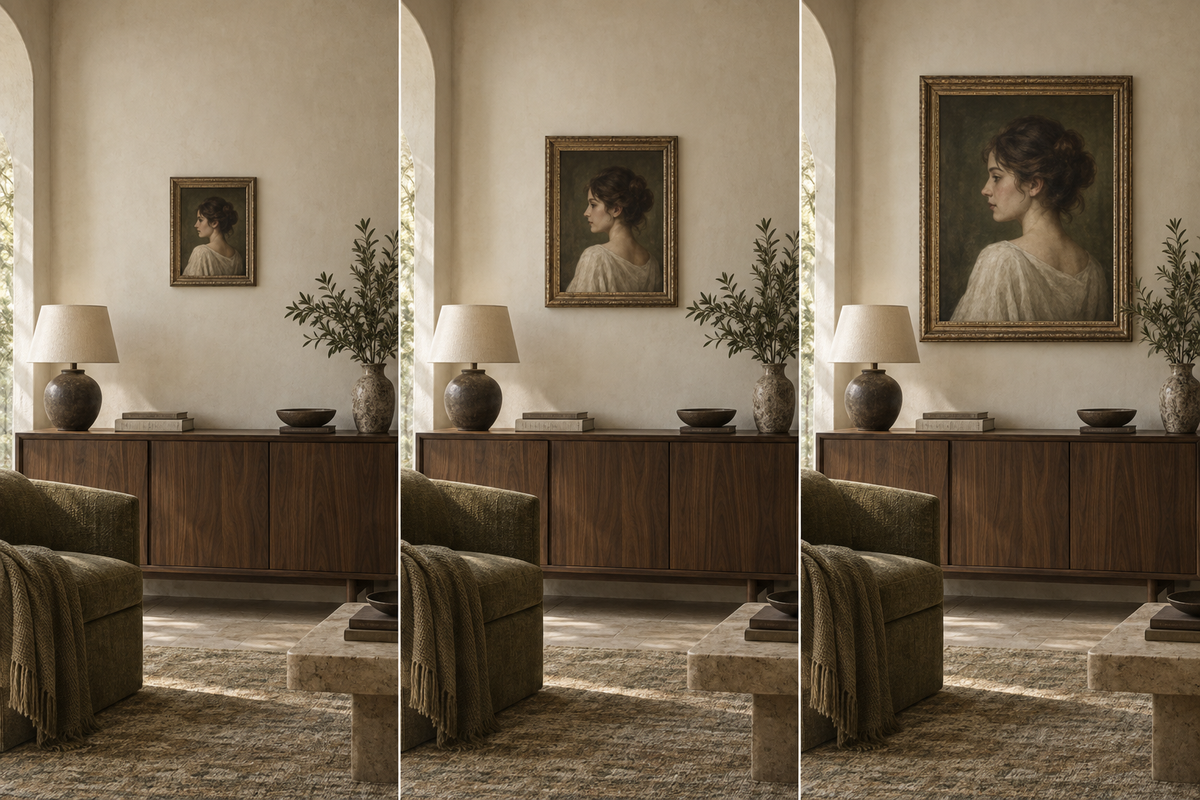
The right dimensions give the sitter enough presence and the room enough space to receive them.
A conceptual comparison of scale in the same imagined room. AI-generated imagery; sizes are illustrative and not a measured installation plan.
It is easy to begin with an empty wall and ask how much of it a painting should fill. But a portrait has another scale inside it: the size of the person as painted.
A generous canvas can contain a relatively small figure in a landscape. A smaller canvas can bring a face close. Choosing dimensions means considering both the painted composition and the room where you will encounter it.
Start with the crop
A head-and-shoulders portrait, a seated half-length figure and a full-length portrait ask for different proportions. A hand, a chair or the space around a figure may be central to the image; removing them to fit a predetermined size can change its character.
Discuss the crop before treating any dimensions as final. Ask to see the proposed composition within the canvas ratio. A photograph that works as a square may need a different arrangement on a tall rectangle.

Give each sitter enough space
Adding people to the same canvas usually makes each face smaller unless the composition changes. A family portrait may need more room for expressions, gestures and the intervals that connect the figures.
There is no universal minimum size for a group. A small, broadly painted scene can be beautiful, while a close family portrait may need more surface to give every sitter the intended presence. Ask how large the heads will appear within the proposed composition, not only how wide the canvas will be.
Consider where you will stand
A portrait viewed across a room has to establish itself at a distance. One beside a reading chair may reward close looking. In a hallway, you may first see it from an angle and then approach it.
Visit the intended wall from the places where you actually spend time. Sit on the sofa, stand in the doorway, walk past it. A size that feels right when you face the wall directly can behave differently in the life of the room.
Measure the surroundings, including the frame
Record the available wall area and the width and height of nearby furniture. Note switches, sconces, shelves or architectural details that affect placement. Send a straight-on photograph with those measurements so the artist can understand the setting.
A frame adds to the outside dimensions and changes the visual weight. As an illustrative calculation, a 40 by 50 cm painted surface with a frame adding 5 cm on every side occupies roughly 50 by 60 cm overall. Actual frame construction varies, so confirm the finished measurements before ordering or hanging.

Test a few sizes at home
Cut paper to two or three possible outside frame dimensions and place it temporarily on the wall using a method suitable for the surface. Leave enough time to see the options in ordinary use.
Compare one size at a time from the main viewing positions. A phone photograph can help you remember the alternatives, but it should supplement looking in the room. Wide-angle pictures can make distances and proportions appear different.
The exercise is not to discover a mathematically perfect rectangle. It is to see which scale feels natural with the furniture, architecture and intended intimacy of the portrait.
Small can be deliberate
A modest portrait in a quiet corner can invite a kind of attention that a large painting does not. It may suit a single head, a private room or a grouping of works with personal significance.
If you choose a smaller size, make the placement intentional. A broad empty wall may leave the work feeling isolated, while a more contained setting can give it the right degree of focus. Scale is relational; it does not have to be grand to feel important.
Large does not have to mean formal
A larger portrait can hold a relaxed expression or an informal family arrangement. Its effect depends on the crop, color, setting and amount of space within the image.
Consider the weight of the finished framed work and how it will be installed. Also look at the practical route into the home: doors, stairs and turns can matter for a substantial object. Resolve these questions before approving dimensions.
Bring the person and the room into one conversation
Share the sitter references, the intended crop, a photograph of the wall and its measurements. If the eventual location is undecided, say so; the portrait can be conceived with flexibility in mind.
The final size should support the image you want to make and the way you want to live with it. A well-chosen scale lets both feel considered.