
How to Choose a Portrait Artist
Look for an artist whose way of seeing you trust, then make sure the working relationship is equally clear.
Look for an artist whose way of seeing you trust, then make sure the working relationship is equally clear.
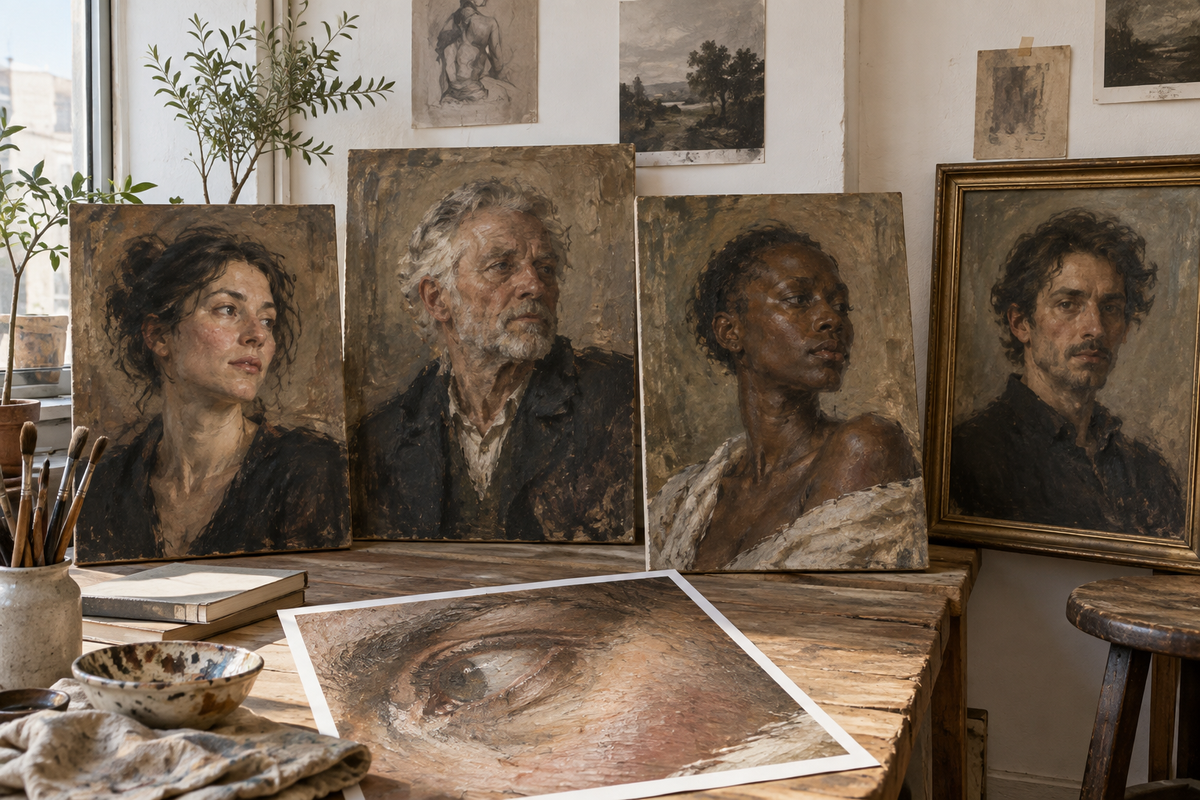
A fictional portfolio arrangement illustrating the kinds of views worth requesting. AI-generated imagery, not an Atelier Vigée client portfolio.
Choosing an artist to paint someone you love is partly a visual decision and partly a matter of trust. You need to respond to the work. You also need to understand how your photographs, questions and knowledge of the sitter will enter the process.
A polished website can introduce an artist, but it cannot answer every question. Spend time with the portfolio and then have a conversation about a commission close to the one you are considering.
Look across a body of work
Begin with several portraits rather than one striking image. Notice how the artist handles different ages, facial structures, expressions and skin tones. Do the sitters retain their individual character? Does a recognizable style allow for difference, or does everyone begin to look alike?
Look for consistency in the things that matter to you. It may be the ease of the poses, the restraint of the backgrounds or the treatment of hands. Consistency does not mean that every painting should have the same composition.
Choose an approach you actually want
Some portraits are finely described, others more openly brushed. Some emphasize atmosphere; others give close attention to every visible form. There is room for more than one kind of successful portrait.
Choose work you would enjoy living with rather than asking an artist to suppress the qualities that attracted you. If you admire one unusual piece in a portfolio, ask whether it represents the approach they would bring to your commission.
Study likeness and interpretation together
When reference comparisons are available with permission, look at what the painter has understood and changed. Has the expression survived? Does the posture feel credible? Does the background support the sitter?
A painting does not need to duplicate a photograph to achieve recognition. At the same time, claims about interpretation should not excuse uncertain proportions or a face that loses its particularity. Ask how the artist uses photographs and what additional material they might need.
Ask to see the object, not only its thumbnail
A full view shows composition. A detail can reveal handling, surface and edges. A photograph of a framed work in a room helps establish scale. Together, these views tell you more than a small, brightly lit image on a screen.
Distinguish finished paintings from digital studies and conceptual mockups. Both can be useful, but they answer different questions. If seeing the work in person is possible, it can clarify how the surface and scale feel. If it is not, request appropriate detail views of relevant examples.

Understand who makes the painting
If you are commissioning through an atelier or service, ask who will paint the work and whether the examples represent that artist's output. Clarify the medium and support, and whether the finished piece is an original painting made by hand.
There is no need to arrive as a materials expert. A straightforward explanation of what will be made, by whom and on what surface is a reasonable expectation.
Make the process concrete
Ask what happens after you send photographs. When is the composition agreed? At what point will you review the work? What kinds of adjustments are included? How are changes outside the original scope handled?
You should also understand the price, payment stages, estimated schedule, framing and delivery arrangements. Get the agreed scope in writing. Clear terms protect the working relationship by reducing uncertainty before the artist begins.
Notice the quality of the conversation
A useful first exchange should make the project easier to understand. The artist may identify a weak reference, explain why a proposed pose needs more information or suggest a composition you had not considered.
Those judgments are part of what you are commissioning. Look for someone who listens closely and can explain a recommendation without dismissing your knowledge of the sitter. You should feel able to ask a question and receive a specific answer.
Match the portfolio to the commission
A beautiful single-head portrait does not by itself show how an artist handles a large family group. If your project includes several sitters, separate photographs, a detailed interior or an older source image, ask for relevant examples or a clear account of how the artist would approach it.
Be equally specific about what you want preserved. A familiar gesture, an expression at a certain age or the atmosphere of a family relationship gives the conversation something more useful than a general request for realism.

A short list of questions to bring
Which examples are closest to the commission I have in mind? What do my photographs make possible, and what is missing? Who will paint the portrait? How are the composition and likeness reviewed? What is included in the written proposal? How will the finished work be framed, prepared and delivered?
The answers should help you connect your response to the paintings with confidence in the process. The right artist is someone whose judgment you want to invite into a portrait, and whose way of working you understand.
Explore Atelier Vigée portraits →