
One Family, Several Photographs: How We Compose a Portrait When No Perfect Photograph Exists
The people who belong together in a portrait do not always appear together in a photograph.
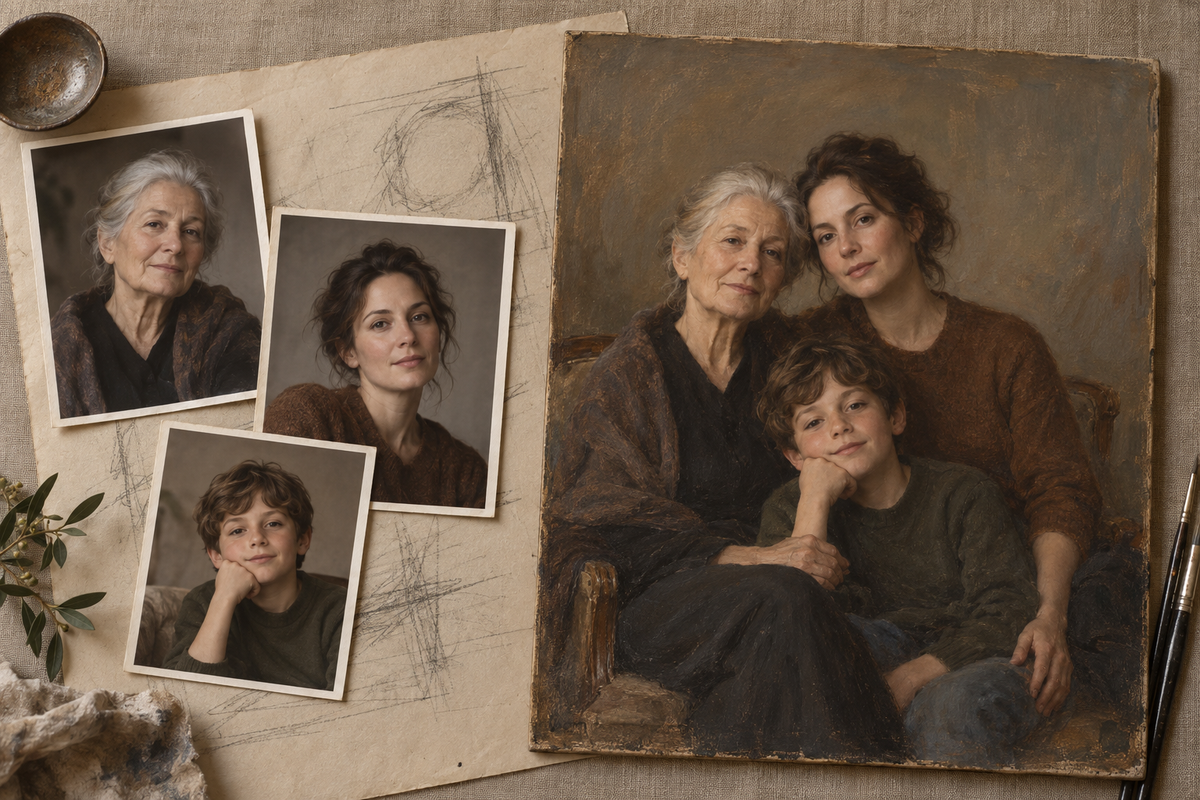
The people who belong together in a portrait do not always appear together in a photograph.
Separate references brought into one imagined composition. AI-generated illustration; the people and painting are fictional.
There may be a photograph in which your mother looks exactly like herself, another in which the children are relaxed, and a third that records a grandfather's familiar posture. None contains the whole family as you want to remember it.
Separate photographs can provide the starting point for one painted portrait. The challenge is to compose a shared scene in which the people feel present together. That requires more than choosing a favorite face for each person.
Begin with the relationship
Before choosing the background, decide what kind of family image you want. A formal group, a quiet conversation and a child leaning into a grandparent each describe a different relationship.
Explain who naturally sits close to whom, whether someone is reserved or animated, and which gestures would feel familiar. These details help the painter avoid arranging people as a row of unrelated individuals. A convincing family portrait has an emotional structure as well as a visual one.

Choose an anchor for each sitter
Identify a principal photograph for each person and explain what it should guide: expression, age, head angle or posture. Add supporting images where the main reference is unclear.
The strongest collection is not necessarily the largest. Several contradictory images can make the intended likeness less clear if they show very different ages, hairstyles or expressions. Agree which moment in each person's life the portrait will represent. When photographs come from different periods, that choice deserves particular care.
Reconcile viewpoint and scale
A close selfie and a photograph taken from across a room may describe faces differently. One person may be seen from above, another from below. Copying both literally can make them feel as though they inhabit different spaces.
The painter needs enough evidence to establish compatible viewpoints and believable relative size. Full or half-length photographs can clarify height, build and posture even when another image supplies the face. If the available material cannot support a proposed pose, a simpler arrangement or an additional reference may produce a better result.
Give everyone the same light
Separate photographs often contain different lighting: bright sun, warm lamps, a shaded garden. A unified painting needs a coherent account of where its light comes from.
The artist can interpret color and shadow, but missing information still matters. A face concealed in deep shadow cannot be understood as reliably as one supported by a clear secondary view. Discuss which features can be adjusted confidently and which would involve invention.

Hands and contact need evidence too
The space between people carries meaning. So does a hand on a shoulder, an arm around a child or the way two figures turn toward one another. These details can make a group feel affectionate without requiring everyone to smile directly at the viewer.
They can also become awkward if they are improvised without sufficient reference. If a particular gesture matters, supply a photograph of it when possible. A composition study is the right place to check that arms, hands, seating and sightlines make sense together.
Use the composition review well
At the study stage, look first at the group as a whole. Does everyone feel appropriately scaled? Are the relationships believable? Is the arrangement too formal, too crowded or too distant for the family you know?
Then confirm the intended expressions, clothing and setting. A study may remain loose; its purpose is to establish direction. Ask what has been settled and what the painting stage will develop. Significant changes to the group are easier to discuss before the finished surface is built.
When the portrait brings generations together
A family may wish to include someone who has died or people who were never photographed together. That can be a meaningful commission, provided its intention is understood clearly.
Tell the artist whether you imagine a plausible gathering at a particular time or a more openly commemorative composition. Share the best evidence available and identify uncertain details. The painting can express a relationship without pretending the assembled scene was a documented event.
A useful starting set
Gather a principal image for each sitter, supporting views of posture and proportion, and any photograph that conveys the family dynamic. Add a short note identifying everyone and the ages you want represented.
The absence of a perfect group photograph does not have to determine the portrait. What matters is whether the references, family knowledge and composition can support one coherent image.
Share your family photographs →