
The Art of Being Seen: What Vigée Le Brun Understood About Portraiture
What Élisabeth Vigée Le Brun’s portraits reveal about likeness, sympathy and the art of truly seeing another person.
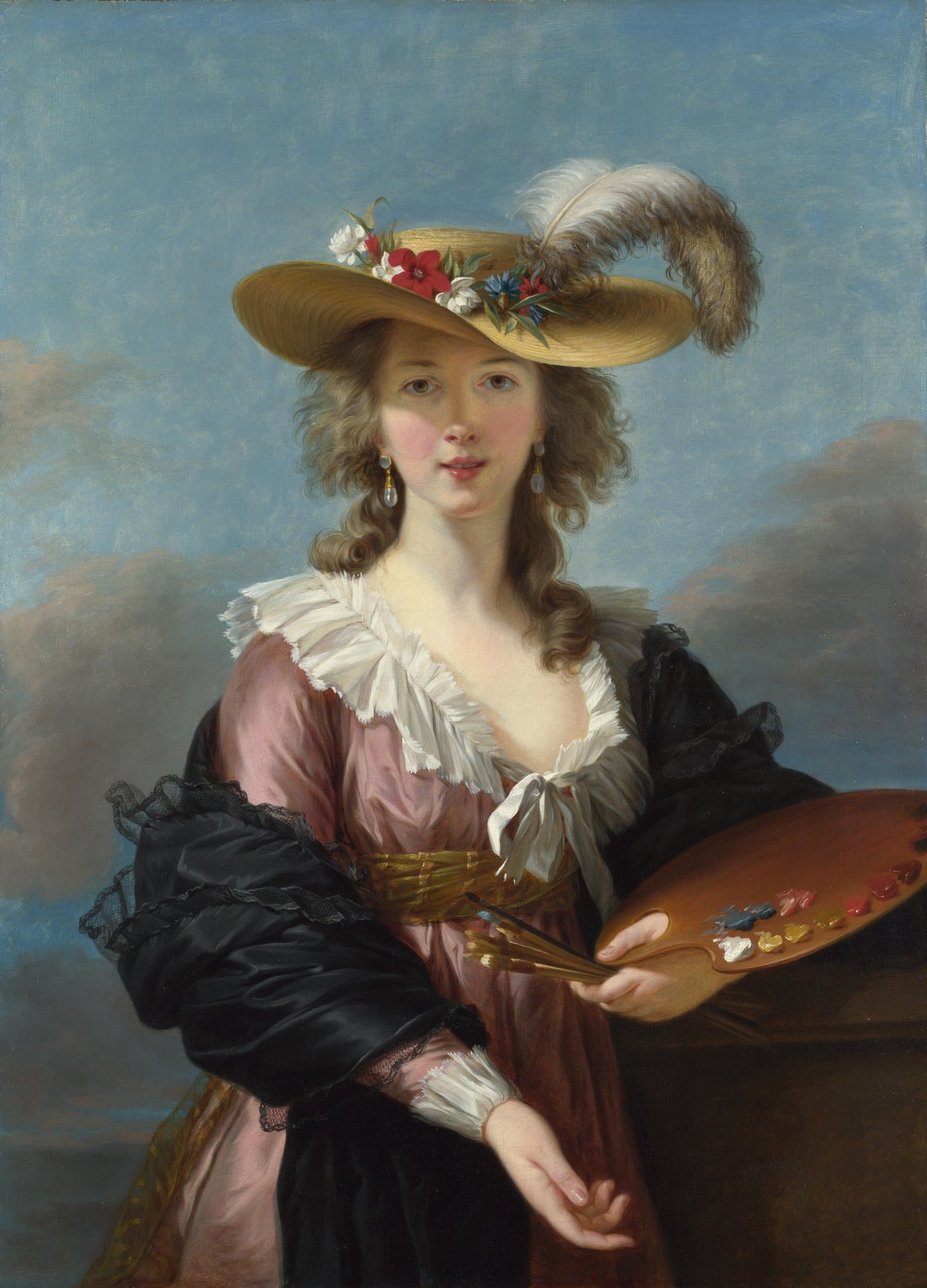
Élisabeth Louise Vigée Le Brun painted some of the most recognizable faces of eighteenth-century Europe. What matters now is not the world of court dress around them, but the quality of attention within them.
Featured artwork: Élisabeth Louise Vigée Le Brun, Self Portrait in a Straw Hat, 1782. Oil on canvas. National Gallery, London, NG1653; bought, 1897. Public-domain reproduction via Wikimedia Commons. Image source; museum record.

There is a difference between being visible and being seen
A face can be recorded with precision and still remain distant. Features may be correct. Clothing may be rendered beautifully. The likeness may be undeniable. Yet the person can feel absent.
To be seen is something else. It means that another person has noticed the way intelligence gathers in an expression, the way reserve changes a posture, or the way warmth appears before a smile becomes obvious. A successful portrait does not merely prove that the sitter was there. It makes a judgment about how that person is present.
That distinction is central to the name Atelier Vigée.
Élisabeth Louise Vigée Le Brun was one of the leading portrait painters of her age. Born in Paris in 1755, she achieved success in France and across Europe, painted Marie Antoinette repeatedly, and built a second international career after leaving France during the Revolution. In 1783 she entered the Académie Royale de Peinture et de Sculpture, one of only four women then admitted. The history is extraordinary. But biography alone is not the reason to return to her work.
What endures is her conviction that likeness and presence are not the same task.
Portraiture begins with attention
The Metropolitan Museum of Art has described Vigée Le Brun as remarkable not only for her technical gifts, but for her understanding of and sympathy with her sitters. That phrasing gets close to the essential quality of portraiture.
Sympathy does not mean sentimentality, and understanding does not mean agreement. It means looking long enough to perceive a person as more than a collection of features. It means noticing the relationship between face, gesture, clothing, setting and self-possession.
In Vigée Le Brun’s portraits, the sitter often meets us directly without appearing pinned in place. A head turns. A body angles away while the eyes return. A hand settles into the composition without becoming a diagram of status. The result can feel poised and socially precise, but also immediate.
The painting has been arranged. The person has not been reduced to the arrangement.

Likeness is an interpretation
Every portrait makes choices. The painter decides which moment of expression to hold, which asymmetries matter, what to simplify and what to insist upon. Even the most natural-seeming image is constructed.
Vigée Le Brun understood that a portrait could feel alive without pretending to be neutral. Her sitters are presented through light, fabric, pose and atmosphere. Their public identity is part of the picture. So is the painter’s sensitivity to how they wished to be encountered.
This is especially clear in her images of Marie Antoinette. The Palace of Versailles records that after Vigée Le Brun’s first major official portrait of the queen in 1778, she was repeatedly commissioned and produced many portraits of her. These were not interchangeable likenesses. Clothing, setting and family relationships helped shape different ideas of the queen: sovereign, fashionable woman, mother, private individual.
A portrait does not simply show us who someone is. It participates in how that person will be remembered.
Presentation can reveal as well as conceal
It is tempting to imagine that elaborate clothing and formal settings belong to the superficial part of portraiture. They do not. Presentation is one of the ways people speak before they say anything.
Fabric can suggest ease or ceremony. A room can establish distance or intimacy. The angle of a chair can make a sitter appear available, guarded, authoritative or at rest. The painter’s task is not to strip these signals away in search of a supposedly pure self. It is to understand how appearance and character meet.
Vigée Le Brun paid close attention to textiles and materials, but the material splendor does not have to overwhelm the person. At her best, surface supports presence. A loosened arrangement of hair, the movement of a sleeve or the interval between figures contributes to the psychological temperature of the picture.
The lesson for a modern portrait is not to borrow the dress or décor of the eighteenth century. It is to treat every visible choice as meaningful.

A portrait is made between people
Portraiture is often described as the artist’s observation of the sitter. That is only half of the relationship. The sitter also observes the artist. Trust, self-consciousness, expectation and conversation enter the work.
Vigée Le Brun’s success depended on more than manual skill. She moved through courts and private circles, negotiated expectations and created images that patrons recognized as both flattering and credible. During more than twelve years abroad, she continued to find patrons among European aristocratic and royal families. Her ability to establish a relationship with sitters traveled with her.
That does not make the portrait a simple act of agreement. A commissioned portrait must still contain artistic judgment. The painter is responsible for the composition, for what the image emphasizes, and for preserving the work as a painting rather than allowing it to become a list of requested corrections.
But judgment is strengthened by attention. The painter brings a trained eye. The sitter and family bring knowledge that no outsider can possess. The portrait emerges between those forms of seeing.
Warmth is not the absence of intelligence
There is a persistent idea that seriousness must appear severe. Vigée Le Brun’s portraits offer another possibility. Grace, directness and warmth can coexist with psychological presence.
A sitter does not need to look solemn to be treated with dignity. A family does not need to be arranged like a monument to become worthy of permanence. Beauty need not erase particularity.
The distinction lies in whether the painting uses warmth to avoid complexity or to make complexity approachable. An attentive portrait allows softness without becoming vague. It allows polish without turning the sitter into an emblem. It can be generous while remaining exact.
This matters now because most people already possess thousands of photographs in which they are visible. The reason to commission a painting is not to obtain another accurate image. It is to experience a different quality of attention.

Look at Julie’s profile beside the face in the mirror: the portrait invites more than one view of its sitter. In the group portrait shown here, glances and touching hands connect the figures. These are readings of the visible paintings, not claims about what the sitters felt.
What Atelier Vigée carries forward
Atelier Vigée is not an attempt to revive the eighteenth century. The name is not a promise of court costume, powdered surfaces or historical imitation.
It names a standard.
Look carefully enough that likeness becomes recognition.
Treat presentation as part of character rather than decoration.
Understand that a portrait can be beautiful without becoming anonymous.
Respect the sitter’s knowledge while accepting the painter’s responsibility to make choices.
Create an image that can hold both the way a person appears and the way they are known.
The modern painted portrait belongs to different homes, families and forms of life than those Vigée Le Brun knew. Yet the fundamental exchange remains. One person offers themselves to be looked at. Another looks with enough discipline, sympathy and judgment to make that attention visible.
A life, painted
A portrait becomes meaningful when the sitter feels more fully present in paint than they would in a merely copied image. That presence may live in the eyes, but it may also live in a shoulder held slightly high, a hand that never fully relaxes, or the particular distance between two people who know each other well.
These details are small. Their meaning is not.
Vigée Le Brun understood that portraiture is an art of selection: choosing what will carry the person forward. Atelier Vigée takes its name from that act of seeing—not as homage alone, but as a commitment to practice it now.